How to Formulate Your Caregiving Plan: Step-by-Step Guide
Caring for an aging parent or spouse starts as a pile of sticky notes, group texts, and a mental list only you can see. A caregiving plan turns that scattered load into one shared document your whole family can actually run.

Last verified · 9 min read
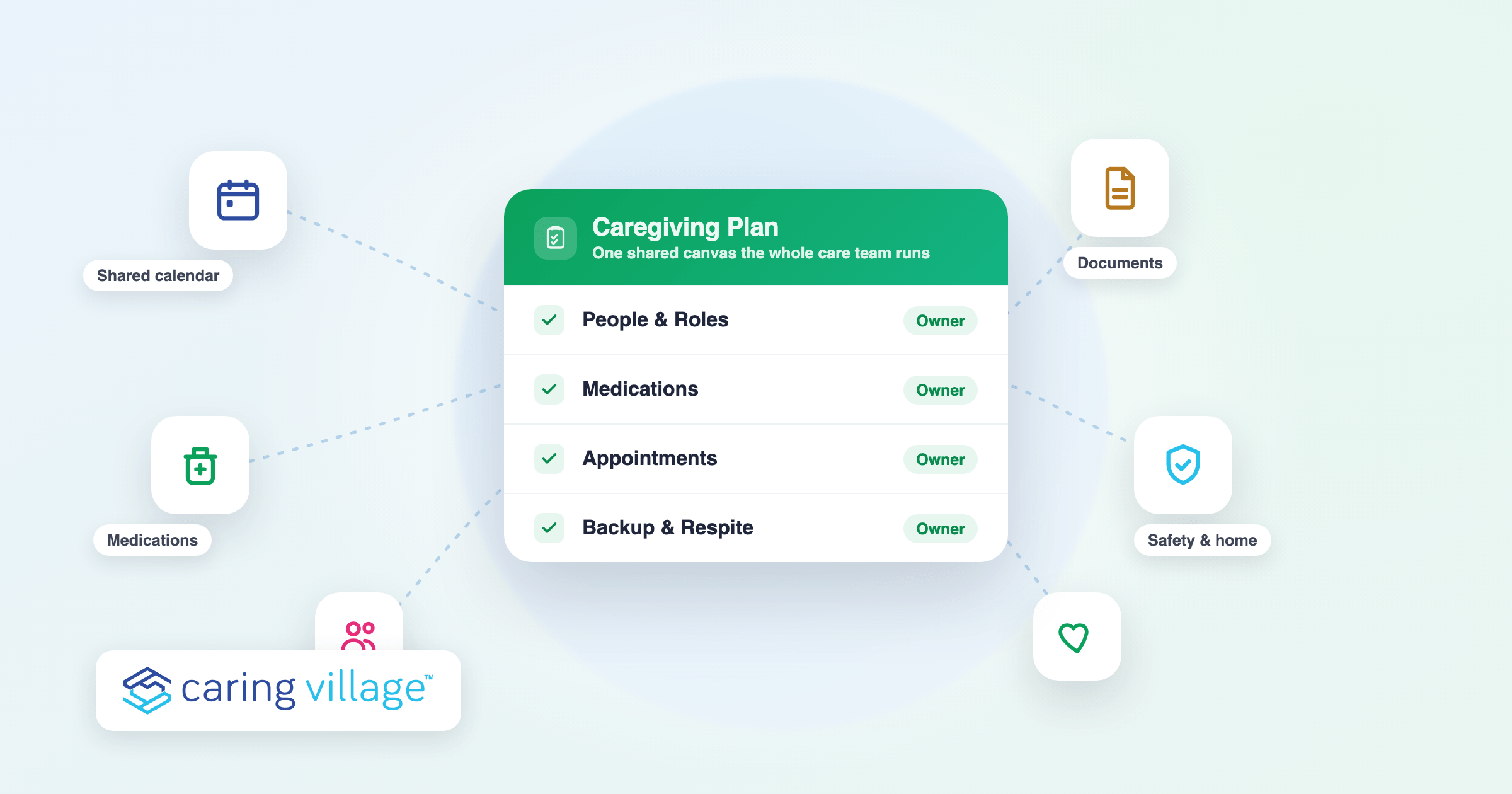
Caring for an aging parent or spouse usually starts as a pile of sticky notes, group texts, and a mental list only you can see. A caregiving plan turns that scattered load into one shared document your whole family can actually run. The plan becomes the operating system for how you coordinate care for an aging parent across siblings, neighbors, and professionals.
This guide shows you how to build one, step by step, without a clinical degree or a free weekend.
You will draft a one-page plan in about 10 minutes, align your family in a 45-minute kickoff, and keep it current with a 15-minute weekly review.
It is written for the adult child, spouse, or relative coordinating care at home, often from another city. If this role is new, start with the complete guide to caring for elderly parents, then return here to document the plan. Grab the free Caregiving Plan Canvas below and start there.
Good to Know
This article is general information, not medical, legal, tax, or financial advice. For decisions about your loved one’s health, medications, legal documents, or benefits, talk with their doctor, an attorney, or a benefits counselor.
The Caregiving Plan Canvas (10-Minute Starter)
A family caregiving plan is a shared, living document that lists your loved one’s needs, medications, providers, schedules, emergency contacts, and who does what. The canvas below is the fastest way to draft one.
Fill in what you know now and leave blanks where you do not. Each row names what to capture, who owns it, and where it lives (a home binder, a shared app, or both), plus a last updated date so nobody acts on stale information.
10 Categories to Capture
One page, ten categories. Fill in what you know, assign an owner to each, and note where it lives so the whole care team works from the same version. Add a last-updated date every time something changes.
| Category | What to Capture | Who Owns It | Where It Lives | Last Updated |
|---|---|---|---|---|
| People and Roles | Loved one, family members, friends, neighbors, paid caregivers, and each person’s contact info and role | Primary caregiver | Binder + app | |
| Daily Routines and Preferences | Wake and sleep times, meals, bathing, activities, likes and dislikes | Whoever is on site most | Binder + app | |
| Medications | Drug name, dose, timing, prescriber, and pharmacy; a photo of each bottle helps | Med point person | App | |
| Appointments and Calendar | Upcoming visits, who drives, and who follows up afterward | Scheduler | Shared calendar | |
| Safety and Home | Mobility aids, fall risks, equipment, and home hazards to fix | Local caregiver | Binder | |
| Documents and Legal | IDs, insurance cards, advance directive, health care proxy, and power of attorney status | Document keeper | App (secure) | |
| Budget and Benefits | Coverage, out-of-pocket costs, and programs still to check | Finance point person | Binder + app | |
| Communication Norms | What gets posted, where, and how often; who to call in a real emergency | Whole village | App | |
| Backup and Respite | Who covers when the primary caregiver is sick or away, and how to reach them | Primary caregiver | Binder + app | |
| Storage and Sharing | Where the plan lives, who can see it, and the current version date | Primary caregiver | Binder + app |
Each canvas row maps to a coordination tool, so the plan is not just a document you file and forget. People, routines, and tasks fit a shared care plan and to-do list; appointments fit a calendar; medications, documents, and updates each get their own home. Turn the agreed hours into a daily or weekly caregiver schedule with a named caregiver and backup for each shift. If the family has not chosen a system yet, compare caregiver apps for families against these same ten categories.
Caring Village brings care plans, calendars, medications, documents, and messages into one shared family hub.
If you want one place to keep all of it, you can create your village care hub, which brings care plans, calendar, medications, documents, and messaging together for the whole family.
Want a deeper medical worksheet to sit alongside the canvas? The National Institute on Aging’s free caregiver worksheets cover care coordination and medical details in printable form.
Turn the Canvas Into a Living Care Plan
Turn the canvas into a living plan with tasks, owners, and dates everyone can open. Caring Village keeps it current instead of trapped in one person’s binder.
- Active care plans with progress you can see
- An owner on every task, visible to the village
- One current version, not five drifting copies
What to Gather Before You Start
Ten focused minutes of prep makes the rest of this go faster. Before you open the canvas, pull together:
- Insurance cards and any Medicare or Medicaid numbers
- A current medication list, ideally with photos of the bottles
- Provider names and phone numbers: primary care, specialists, and pharmacy
- Emergency contacts for family and neighbors
- Legal document status: advance directive, health care proxy, and power of attorney, even if the answer is “we still need to do this”
- Access to a shared calendar or app the whole family can open
If you are not sure what belongs in each pile, Caring Village’s free caregiver preparedness checklists walk you through gathering the right paperwork before a crisis forces the issue.
Build Your Caregiving Plan in Eight Steps
Work these in order the first time. After that, you will mostly revisit Step 8.
1) Clarify Needs and Risks
Start with what your loved one can and cannot do on their own. Note help needed with everyday tasks like bathing, dressing, meals, and medications, and with bigger tasks like managing money, driving, and appointments. The guide to caring for a disabled family member adds disability benefits, home adaptations, documentation, and respite considerations to this needs review.
Flag anything that changed recently, especially after a hospital stay. If you become a caregiver overnight after a hospitalization or fall, capture the current facts first and leave nonurgent decisions for the family kickoff. A discharge home is the moment most plans are born, and it is when needs shift fastest.
For a fuller picture of what caregiving actually involves day to day, this breakdown of common caregiver responsibilities helps you scope the plan honestly instead of guessing.
Common Pitfall
Planning for a good day. Write the plan for a hard day, then a good day is easy.
2) Align Roles and Permissions
Decide who does what, and who is allowed to make decisions. When evaluating elderly care apps for families, check that permissions match the roles you just assigned. Name a point person for medications, one for the calendar, and one for documents so no single person carries everything.
This is also the moment to check legal permissions. An advance directive records your loved one’s wishes.
It usually has two parts: a health care proxy (sometimes called a durable power of attorney), who makes medical decisions if they cannot, and a living will, which spells out treatments they do or do not want.
Medicare Part B covers voluntary advance care planning during the yearly wellness visit, so a doctor can help prepare these documents.
When paid caregivers join the family team, set expectations early. Here is how families and professional caregivers work side by side without stepping on each other.
Common Pitfall
Assuming everyone knows who is in charge of what. Write the owner next to each task, out loud, in front of the family.
3) Build Your Shared Calendar and To-Dos
Put the next 60 to 90 days of appointments into one calendar the whole village can see. For each visit, mark who drives and who reports back afterward.
Turn recurring needs into shared to-dos: refills, standing rides, weekly check-ins. Distributing tasks is the whole point, so one person is not silently holding the schedule in their head.
Every Appointment, Every Driver, One Calendar
Give every visit a time, driver, and follow-up owner on one shared calendar. Caring Village lets the family update the next appointment without starting another thread.
- A shared calendar the whole family can edit
- Each event names the driver and the follow-up
- Reminders so a refill or a ride never slips
If aligning schedules across siblings is the real headache, this deeper look at coordinated caregiver calendars is the next read.
Common Pitfall
A calendar only one person updates. If it is not shared and editable, it will drift.
4) Consolidate Medications and Documents
Build one current medication list: name, dose, timing, prescriber, and pharmacy. If timing, missed-dose alerts, or multi-profile tracking are the harder problem, compare medication management apps before choosing the reminder layer. A photo of each bottle and label saves you in an emergency room at 2 a.m.
Do the same for documents. Keep IDs, insurance cards, and legal paperwork in one secure place, digital and paper, so anyone authorized can find them during an appointment or a crisis.
Caring Village’s caregiver preparedness checklists help you confirm nothing important is still floating in a drawer.
Common Pitfall
Meds in one sibling’s notes app, documents in a shoebox. Scattered beats organized only until the first emergency.
5) Set Communication Norms
Agree on what gets shared, where, and how often, so updates stop living in five separate text threads. A simple rule works: routine updates go in the shared app, and a phone call is reserved for a real emergency. Families using an update journal should compare CaringBridge alternatives before assigning private tasks, medications, or documents to the same space.
For long-distance family, this matters even more. These long-distance caregiving tips cover how to stay genuinely useful from another state.
Common Pitfall
The primary caregiver repeating the same appointment update in three group chats. One post, one place, everyone sees it.
6) Plan for Emergencies and Respite
Write down who covers when the primary caregiver is sick, traveling, or simply burned out. Name the backup, list how to reach them, and store the emergency instructions where the backup can actually find them.
Respite is not a luxury line item. If exhaustion is already affecting sleep, patience, or health, use these caregiver burnout solutions while the family redistributes the plan. A plan with no backup fails the first week someone gets the flu.
Common Pitfall
No named backup. “We’ll figure it out” is not a plan, it is a future 6 a.m. panic.
7) Take a Budget and Benefits Snapshot
Sketch what care costs and what is covered. Family caregivers spend, on average, roughly $7,200 a year out of pocket, according to AARP’s 2025 report, so getting ahead of costs is not premature.
List current coverage, likely out-of-pocket expenses, and programs still worth checking. If an existing policy or new coverage is part of the discussion, compare current long-term care insurance companies and record the policy details in the plan. When family bandwidth runs short, compare it against paid help. These guides to in-home caregiver costs and hiring home care help set realistic expectations before you commit.
Common Pitfall
Treating money as a later problem. Costs compound quietly, then arrive all at once.
8) Evaluate and Update
A plan is only useful if it stays current. The National Institute on Aging advises caregivers to check in regularly and update the plan as circumstances change, especially after a health event.
Two rhythms keep it alive:
- A 15-minute weekly review: check next week’s appointments, confirm refills, and name who is on point for rides and updates.
- A deeper refresh any time health or medications change, and at least once a year otherwise.
For context, a nursing home builds a formal care plan with staff and reassesses it at least every 90 days. A home caregiving plan is family-run, so that cadence is yours to hold.
Common Pitfall
The plan that never gets reopened. Put the weekly review on the calendar like any other appointment.
How to Run a 45-Minute Family Kickoff Meeting
Once your canvas is drafted, get the family on one call to align. Keep it to 45 minutes with a simple agenda:
Walk through your loved one’s current needs and any recent changes.
Go row by row through the canvas and name who owns medications, calendar, documents, finances, and backup coverage.
Agree where updates get posted and what counts as a real emergency.
Name the backup caregiver, set the weekly review time, and decide where the plan lives.
Sample language for the hard part: “I can’t be the only one holding this. Can you own the calendar so I can focus on medications?” Direct requests land better than hoping someone volunteers.
How to Know You Did It Right
Run this quick check. A finished first draft should have:
- A one-page canvas filled in, with blanks noted rather than ignored
- The next 60 to 90 days of appointments on a shared calendar
- A reconciled medication list with prescriber and pharmacy
- Advance care planning status captured, even if the next step is “still to do”
- A named backup caregiver with contact details
- The plan stored and shared where the whole village can reach it
If all six are true, you have a plan you can actually run, not just a document you made once.
Troubleshooting Common Caregiving Plan Problems
Fix: give the 15-minute weekly review a standing calendar slot and an owner, and reconcile the med list after every hospital stay.
Fix: name a backup for each critical role now, while things are calm, and store emergency instructions where the backup can reach them.
Fix: rebalance tasks and take an honest look with this caregiver burnout self-assessment. A plan that burns out its owner does not last.
Caregiving Plan FAQs
What should a family caregiving plan include?
Names and contacts, health conditions, medications, providers, insurance, emergency contacts, daily routines, safety notes, legal documents, communication norms, and named backups. The canvas above captures each one.
How often should we update our caregiving plan?
Do a 15-minute review weekly, refresh it any time health or medications change, and give it a full look at least once a year. The National Institute on Aging advises updating the plan as circumstances change.
Who should be part of the caregiving team, and what are typical roles?
Usually an adult child or spouse as primary caregiver, plus family, friends, neighbors, and paid caregivers. Typical roles are a medications point person, a scheduler, a document keeper, a finance point person, and a named backup.
Where should we store and share the plan so everyone stays in sync?
Keep it in two places: a home binder for anyone on site, and a shared app so long-distance family can see the same version. Whatever you use, keep one current copy rather than several drifting ones.
Is a family caregiving plan the same as an advance care plan?
No. A family caregiving plan runs daily coordination. An advance care plan records medical wishes through documents like a health care proxy and living will. You want both, and the caregiving plan should note where the advance directive lives.
Where can I find a free caregiving plan template?
Start with the canvas on this page. For a deeper medical worksheet, the National Institute on Aging offers free caregiver worksheets.
What to Do Next
You do not need a perfect plan today. You need a first draft your family can run and improve.
Fill in the canvas, hold the 45-minute kickoff, and put the weekly review on the calendar.
When you are ready to move it out of a binder and into one shared space, you can create your village care hub to keep care plans, calendar, medications, documents, and messaging in one place, and invite your inner circle so nobody is coordinating alone.
If your care team is growing, you can compare the Free, Circle, and Village plans to see which fits a larger family.
Move From a Written Plan to Shared Action
Caring Village turns the family care plan into shared schedules, assigned tasks, medication routines, and timely updates.
- Roles and tasks with clear owners
- Shared schedules and medication routines
- Updates visible to the care team
“This is a wonderful tool, takes so much pressure off family by making it a one stop source for keeping in touch.”
App Store reviewer
Sources and verification
- National Institute on Aging. Sharing Caregiving Responsibilities. Verified July 2026.
- National Institute on Aging. Caregiver Worksheets. Verified July 2026.
- Medicare. Advance Care Planning Coverage. Verified July 2026.
- Medicare. Nursing Home Care Plans and Assessments. Verified July 2026.
- AARP. New Report Reveals Crisis Point for America’s 63 Million Family Caregivers, 2025. Verified July 2026.
This guide is general information for family caregivers and is not medical, legal, financial, or tax advice. Programs and coverage change; confirm current details with the provider, plan, or a licensed professional before you rely on them.