Cost of At-Home Dementia Care in 2026: What Families Actually Pay
At-home dementia care is priced by the hour, so your monthly number depends almost entirely on how many hours of coverage your loved one needs. Here is the real math, the break-even point, and the programs that help pay.

Last verified · 9 min read
This article is general information, not medical, financial, legal, or tax advice. Costs and program rules change and vary by state. Confirm anything that affects your family with a licensed professional or the official program.
Most families start the same way: your mom needs more help than one person can give, and you have no idea what that actually costs.
The honest answer is that at-home dementia care is priced by the hour, so your monthly number depends almost entirely on how many hours of coverage your loved one needs and how fast that need is growing. The broader in-home care cost guide adds state medians and a general estimator for families without dementia-specific needs.
This guide turns that into real math.
You will get the latest published national hourly median, verified in July 2026, a worksheet to translate your loved one’s needs into a monthly cost, and the point where staying home starts costing more than memory care.
You will also get a plain rundown of the programs that may help pay.
No vague ranges, no scare tactics, just the numbers and how to use them.
What At-Home Dementia Care Costs in 2026
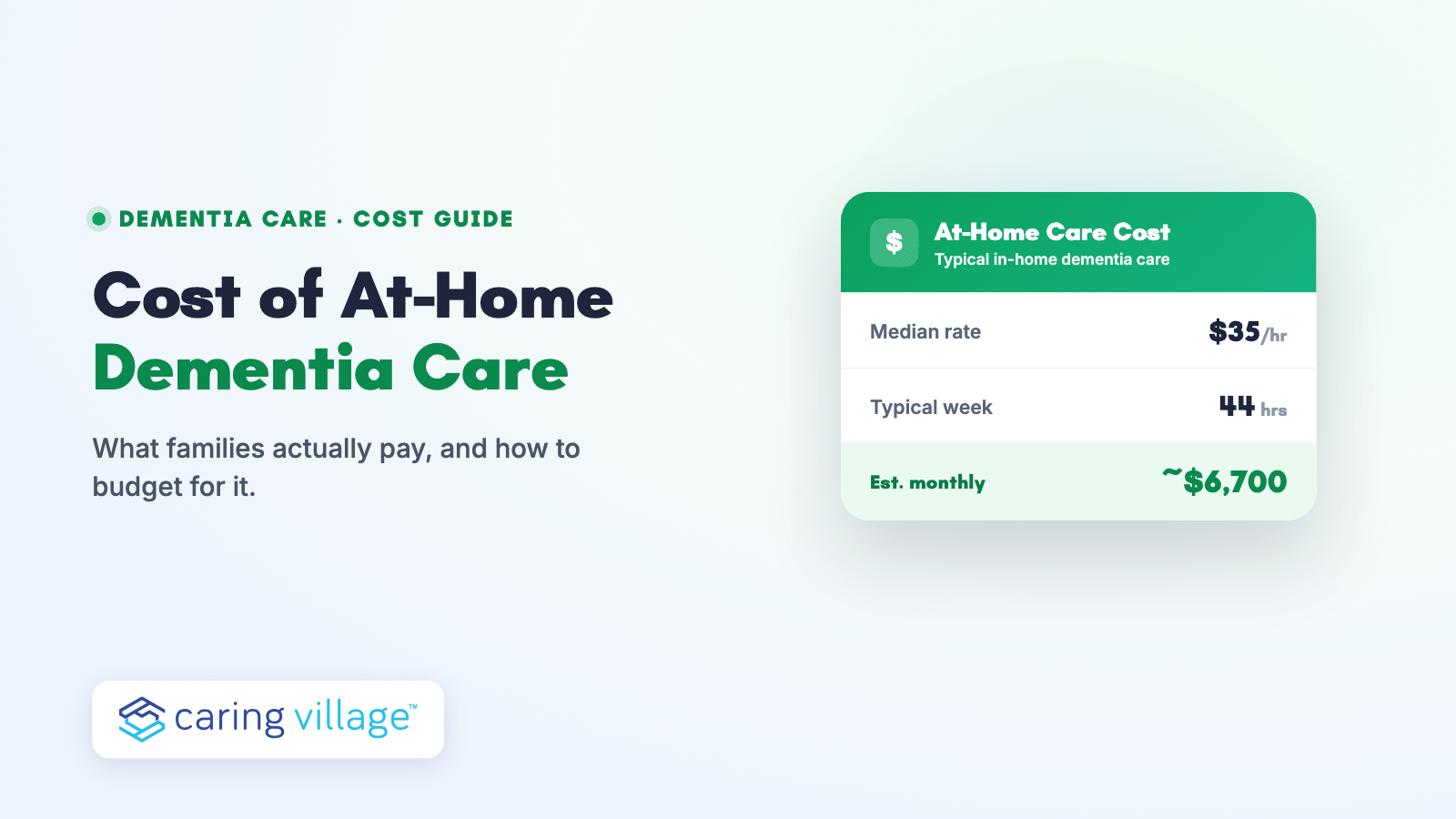
- The national median for a non-medical caregiver is about $35 per hour as of 2025, per the 2025 CareScout (Genworth) Cost of Care survey. Your local rate can run meaningfully higher or lower.
- A few companion hours a week is a few thousand dollars a month. Around-the-clock care is not. At $35 per hour, 24/7 coverage lands near $25,500 per month (roughly 730 hours). A Place for Mom put its own 2026 estimate at about $24,733 per month.
- Memory care runs about $6,690 per month in 2026, per A Place for Mom, and that price already includes housing, meals, and supervision. In-home care is hours only, on top of the rent or mortgage you already pay.
- Medicare does not pay for long-term custodial care (help with bathing, dressing, eating) at home, per Medicare.gov. Medicaid, VA benefits, PACE, and long-term care insurance may help if your loved one qualifies.
Dementia care tends to cost more than routine home care because the need grows over time and often shifts toward supervision, overnight help, and specially trained aides.
Dementia Home-Care Budget Worksheet
You do not need a spreadsheet or a financial planner to get a usable number. Four steps get you to a monthly estimate you can actually plan around.
1) Map Needs to Hours
Start with what your loved one cannot safely do alone, then estimate hours per week.
- Companion and safety supervision: meals, reminders, light housekeeping, company. Often 14 to 28 hours a week early on.
- Personal care (ADLs): bathing, dressing, toileting, mobility, help with eating. This pushes you toward daily shifts.
- Day and night coverage: wandering, sundowning, or falls at night can mean overnight or waking care, which changes the math fast.
Write down a weekly hour estimate for a typical week. That single number drives everything else.
2) Multiply Hours by Your Local Rate
Use the national median of $35 per hour as a starting point, then adjust for where you live. Big metros and overnight or specialized dementia care run higher; some rural markets run lower.
To pressure-test your local number against what caregivers actually charge, request a few local quotes. Caring Village partners with Care.com so you can search for caregivers near you. Caring Village may earn a commission from this partner link, at no extra cost to you.
3) Add the Cost Drivers Most Families Forget
The base rate is rarely the final rate. Add for:
- Overnight and waking-night care, weekend, and holiday differentials.
- Short-shift minimums (many agencies bill a 3 or 4 hour minimum per visit).
- Two-person transfers if your loved one needs help moving safely.
- Agency overhead if you hire through an agency instead of privately.
4) Sense-Check Against Memory Care
If your weekly hours are climbing toward all-day or overnight coverage, compare your monthly total to the memory care median before you commit. The break-even section below shows exactly where that line sits.
Once you have an estimate, building a written caregiving plan keeps the whole family working from the same hours, budget, and expectations instead of one person carrying it in their head.
Weekly Hours to Monthly Cost Reckoner
Find the row closest to your loved one’s weekly hours to estimate the monthly cost using the latest 2025 national median, verified in July 2026. Then swap in your local rate to personalize it.
| Weekly Hours | What It Usually Covers | Approx. Monthly Cost |
|---|---|---|
| 14 hrs | A few companion or safety visits | $2,100 |
| 28 hrs | Daily companion care, part of each day | $4,250 |
| 44 hrs | Roughly one full-time weekday shift | $6,700 |
| 60 hrs | Extended daily coverage | $9,100 |
| 84 hrs | Long days plus some nights or weekends | $12,700 |
| 120 hrs | Near-constant daytime and evening care | $18,200 |
| 168 hrs (24/7) | Around-the-clock coverage | ~$25,500 |
24/7 rule of thumb: around-the-clock care is roughly 730 hours a month. Multiply 730 by your local hourly rate to get the monthly cost.
At $35 per hour that is about $25,500. This is care hours only and does not include rent, food, or utilities.
What Drives the Cost Up or Down
Two families in the same city can get very different quotes. The biggest swing factors:
- Care intensity. Companion supervision is cheaper than hands-on personal care, which is cheaper than skilled or two-person care.
- Time of day. Nights, waking-night supervision, weekends, and holidays usually carry higher rates.
- Training. Aides with real dementia experience often cost more, and are usually worth it for wandering or aggression.
- Location. Metro rates run above the national median; some rural areas run below it.
- How you hire. An agency handles vetting, backup coverage, taxes, and insurance, and charges for it. Private hire can be cheaper but puts payroll, taxes, and coverage gaps on you. This guide helps relatives and paid caregivers define handoffs after the hire.
- Home safety add-ons. Wandering and fall risk often mean one-time equipment costs, from GPS trackers for dementia wandering to the room-by-room changes in a dementia-friendly home.
Live-In Care vs 24/7 Rotating Shifts
These sound similar and are priced very differently.
Live-in care means one caregiver stays in the home, with defined sleep and break periods.
It can be cheaper than hourly around-the-clock care because you are not paying an hourly rate for every one of the 168 weekly hours. It only works if your loved one sleeps through the night reliably.
24/7 rotating shifts mean caregivers work in shifts so someone is always awake and alert. Sundowning or other waking-night needs may require rotating supervision, the most expensive option because every hour is billed.
At-Home Care vs Memory Care: The Break-Even Moment
Here is the comparison most families never get in plain numbers.
Memory care‘s 2026 median is about $6,690 per month (A Place for Mom), and that price bundles housing, meals, activities, and 24-hour supervision. In-home care buys hours of help and nothing else, so you keep paying the mortgage, utilities, and groceries on top.
Where In-Home Cost Crosses the Memory Care Median
Each bar is the monthly in-home cost at the $35 per hour median for that weekly-hours band. The dashed line is the 2026 memory care median of about $6,690 a month.
The break-even sits around 44 hours a week, roughly one full-time shift. Below that, staying home is usually the cheaper option and keeps your loved one in familiar surroundings.
Once supervision needs push you toward all-day or overnight care, in-home costs pass the memory care median quickly, and that is before you add the housing costs a facility already covers.
The number is only half the decision. Weigh what each setting includes: social contact, transportation, on-site staff at 3 a.m., and how well your loved one tolerates change. A lower monthly cost is not a bargain if the care itself does not hold up.
Keep Your Hours and Budget in One Shared Plan
Turn the weekly hours and monthly budget into a plan everyone can follow. Caring Village keeps shifts, care tasks, and cost notes together for the family.
- Weekly and daily care plans the family shares
- Every shift, task, and budget note in one place
- Works across the whole care team, even from a distance
How Families Actually Pay for It
Very few families cover dementia care from income alone. These are the main paths, with the official rules to check.
- Medicare. Does not cover long-term custodial care at home. It may cover limited, intermittent skilled home health (nursing or therapy) when a doctor orders it, not day-to-day help with bathing or meals. See Medicare’s long-term care page.
- Medicaid (HCBS waivers). Many states cover in-home care through Home and Community-Based Services waivers, though scope and waitlists vary widely by state. The KFF overview of Medicaid home care explains how uneven this is.
- VA Aid and Attendance. Wartime veterans and surviving spouses who need help with daily activities may qualify for an added monthly pension benefit. Check eligibility and current rates at VA.gov.
- PACE. The Program of All-Inclusive Care for the Elderly delivers nursing-home-level support while your loved one lives at home, for those who qualify. See Medicare’s PACE overview.
- Long-term care insurance. If your loved one has a policy, benefits usually trigger with cognitive impairment or needing help with two or more daily activities, up to a daily maximum. Read the specific policy. Families still shopping can compare active long-term care insurance companies and benefit models.
- Tax deductions. Qualified long-term care and in-home nursing costs may count as deductible medical expenses if you itemize and clear the AGI threshold. See IRS Publication 502, and confirm with a tax professional.
Eligibility for these programs is specific and changes. Treat the links above as the source of truth, and verify your family’s situation with the program or a qualified advisor. This is general information, not financial, legal, or tax advice.
Keep Every Benefit Letter and Policy in One Place
Store insurance cards, VA letters, Medicaid approvals, and long-term care policies in one secure family folder. Caring Village keeps each file ready for the next deadline.
- Shared folders for legal, financial, and medical files
- Secure storage the whole care team can reach
- No more hunting through email or a group text
Real-World Examples
Three snapshots of how the same math plays out at different stages of need.
A daughter arranges companion care so her father is not alone during the workday.
Well under the memory care median, and he stays in his own home.
A family needs daily help plus two overnights for wandering, about $2,400 above the memory care median.
This is the stage where many families run the full comparison.
Waking-night supervision pushes a family to 24/7 rotating shifts.
At that level, most weigh memory care, a live-in arrangement, or splitting coverage across family and paid caregivers. If relatives absorb the unpaid hours, include a plan to prevent caregiver burnout.
Next Steps: Get Local Numbers and Organize the Plan
- Replace the median with a real quote. National numbers get you in the ballpark; local agencies get you the actual price. If you are ready to compare candidates, the guide to hiring an in-home caregiver or home care provider walks through vetting and interviews.
- Coordinate the hours you just budgeted. Once you know the weekly shifts, a shared system beats a group text. These dementia caregiver apps compare tools for routines, medications, safety, and family updates. In Caring Village, you can create a free Village, put every shift on one shared calendar, assign to-dos, and keep the medication list and documents in one place for the whole care team.
- Prepare before the next stage. Dementia needs grow, so plan for it. Caring Village’s caregiver preparedness checklists help you get financial, legal, and home-safety pieces in place before a crisis forces the decision.
Find Trusted Caregivers Through Care.com
Caring Village has teamed up with Care.com to make finding an in-home caregiver simpler. The directory lets families search by experience, qualifications, and location, and review candidates before reaching out.
It is a practical way to get local hourly quotes and replace the national median with a real number for your budget.
Search the Care.com directory Care.com is a Caring Village partner. Directory features and any membership offers are set by Care.com and can change.Frequently Asked Questions
How much does in-home dementia care cost per hour?
About $35 per hour as a national median in 2025, per the 2025 CareScout Cost of Care survey. Your local rate depends on your area, the time of day, and how specialized the care needs to be.
How much is 24/7 in-home care for dementia?
Around-the-clock care is roughly 730 hours a month, so at $35 per hour it lands near $25,500 a month. A Place for Mom’s 2026 estimate is similar, about $24,733 a month. That covers care hours only, not housing or food.
Does Medicare pay for dementia care at home?
Not for long-term custodial care like help with bathing, dressing, or meals. Medicare may cover limited skilled home health when a doctor orders it. See Medicare.gov. This is general information, not medical or financial advice.
What programs help pay for dementia care at home?
Depending on eligibility: Medicaid HCBS waivers, VA Aid and Attendance, PACE, long-term care insurance, and possible medical-expense tax deductions.
When does home care cost more than memory care?
Around 44 hours a week (about $6,700 a month), in-home care reaches the 2026 memory care median of about $6,690. Past that, home care usually costs more per month, and you still pay housing costs a facility would include.
Coordinate Dementia Care Within Your Budget
Caring Village helps families connect the care budget to schedules, medication routines, documents, and the people sharing the work.
- Schedules tied to the care plan
- Medication and document tracking
- Updates across separate family villages
“After my husband's stroke, I felt completely overwhelmed. A friend recommended it and it helped me organize everything — appointments, medications, insurance documents.”
Caregiver for Husband

Sources and verification
- CareScout (Genworth). 2025 Cost of Care survey, non-medical home care aide national median (~$35/hour, up 3% year over year), investor.genworth.com press release. Verified July 2026.
- A Place for Mom. Cost of memory care (~$6,690/month, 2026), aplaceformom.com. Verified July 2026. Credited by name.
- A Place for Mom. 24-hour in-home care estimate (~$24,733/month, 2026), aplaceformom.com. Verified July 2026. Credited by name.
- Medicare.gov. Long-term care coverage boundary (custodial care not covered; limited skilled home health only), medicare.gov/coverage/long-term-care. Verified July 2026.
- KFF. Medicaid home care and HCBS waivers, scope and waitlists by state, kff.org. Verified July 2026.
- U.S. Department of Veterans Affairs. Aid and Attendance and Housebound benefits, va.gov. Verified July 2026.
- Medicare.gov. Program of All-Inclusive Care for the Elderly (PACE), medicare.gov. Verified July 2026.
- IRS. Publication 502, Medical and Dental Expenses (long-term care and in-home nursing), irs.gov. Verified July 2026.
The 24/7 monthly figure (~$25,500) is a calculation: roughly 730 care hours a month multiplied by the $35 per hour national median, corroborated by A Place for Mom’s independent 2026 estimate. All figures are national medians; local rates and program rules vary by state and change over time.