


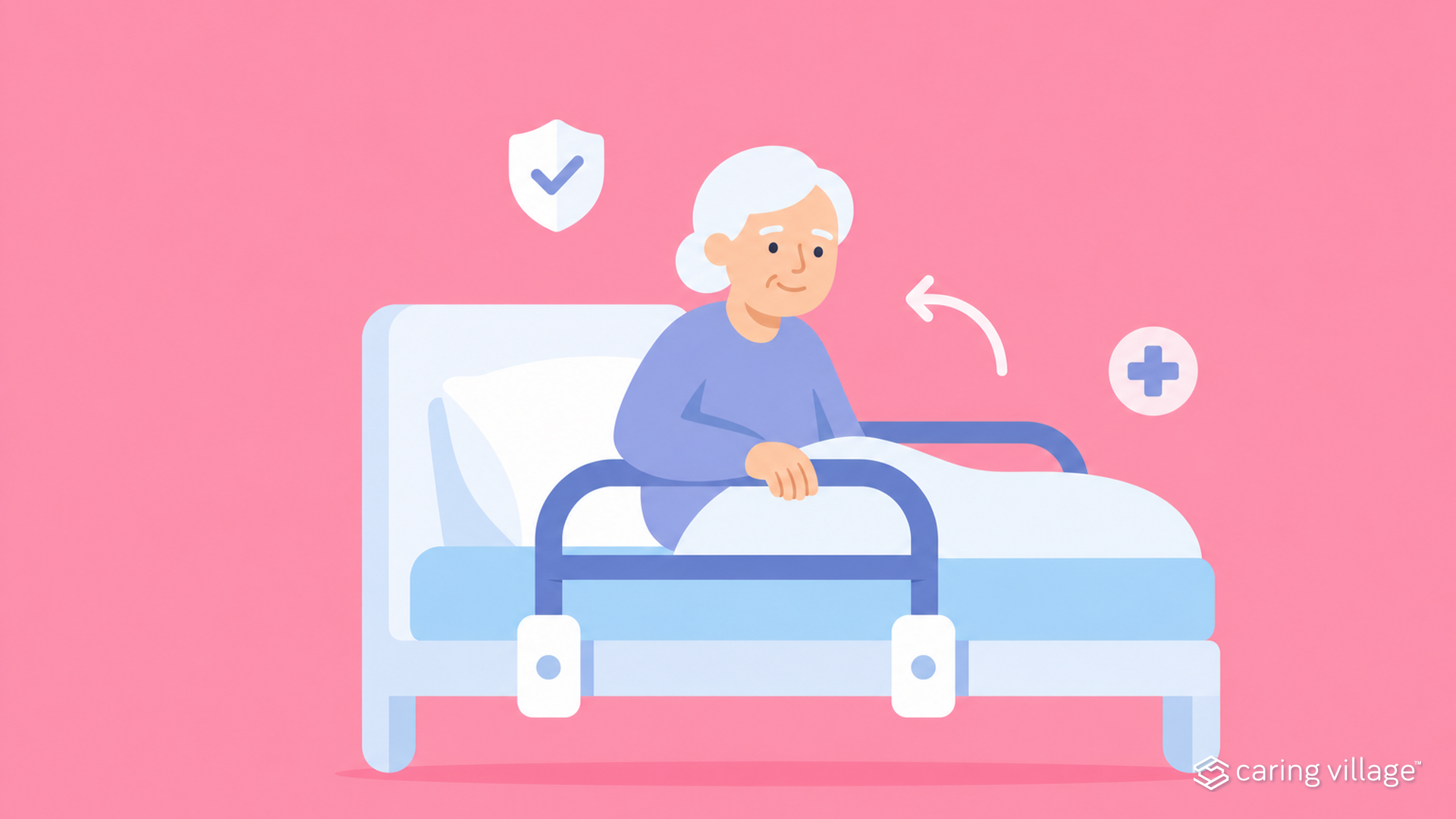
Getting in and out of bed can be extremely difficult for some older adults. If your parent has difficulty getting into or out of bed, repositioning, or is at risk of rolling out, then a bed rail may be the right answer.
But a bed rail is also a device linked to hundreds of deaths, and the wrong rail, or the right rail used by the wrong person, can be more dangerous than no rail at all.
This guide is built around one goal: helping you choose a bed rail safely, including knowing when not to use one. If you are setting up a whole room, our guide to a safe bedroom for limited mobility pairs well with this one.
⚠️ Safety First: Read This Before You Buy
Adult portable bed rails carry a real, documented risk of entrapment. That means a person becoming trapped between the rail and the mattress, between the rail's bars, or under the rail, in a position they cannot escape.
Entrapment can cause serious injury or death by asphyxiation.
The U.S. Consumer Product Safety Commission (CPSC) identified 284 entrapment deaths involving adult portable bed rails between January 2003 and December 2021, with most reported incidents resulting in a fatality.
In response, the CPSC adopted a federal mandatory safety standard that took effect in 2023 (16 CFR Part 1270, which incorporates the ASTM F3186-17 standard).
Before that date, manufacturers had no obligation to meet any safety standard, and CPSC testing found most rails on the market did not comply.
- Only buy a rail that meets the current standard. Look for an explicit statement that the product passed ASTM F3186-17. Rails manufactured after August 21, 2023 are legally required to comply.
- Bed rails are not for everyone. People with cognitive impairment, restlessness, or the ability to climb over the rail face the highest entrapment risk. See "Who Should NOT Use a Bed Rail" below.
- A bed rail is never a restraint. It must never be used to keep someone in bed against their will or ability. Restraint without supervision can lead to entrapment, injury, and death.
- Recalls happen, so check before and after you buy. In March 2026, the CPSC and Vive Health recalled about 122,000 adult portable bed rails (including the Vive Health Compact Bed Rail, model LVA2009SLV) after two reported entrapment deaths. Check CPSC.gov/Recalls and the manufacturer's recall page before and after purchasing.
- If in doubt, ask a clinician. If you have any doubt about whether a bed rail is right for your loved one, talk to their physician, nurse, or home health clinician first. A clinician can assess fall risk and recommend the safest option for that specific person and bed.
Bed Rail vs. Assist Handle vs. Full-Length Safety Rail
People use "bed rail," "bed handle," and "safety rail" interchangeably, but they describe three different products with very different risk profiles. Choosing the right category matters more than choosing a brand.
| Type | What it does | Entrapment risk |
|---|---|---|
| Assist handle | A compact grab bar used purely as a transfer aid, to push up, sit, or stand. Not a barrier, and does not span the bed. | Low |
| Half rail | A partial-length rail along one side of the bed. A partial barrier and a transfer aid. | Moderate |
| Full-length safety rail | A rail running most or all of the bed's length to reduce rolling-out risk. The most containment. | Highest |
What Are Bed Rails?
Bed rails are railings that go along the side of a bed and often connect to both the headboard and footboard, preventing a person lying in bed from rolling out easily. They take on various names, including bedside rails, half rails, safety rails, bed handles, assist bars, hospital bed rails, and adult portable bed rails, and can be used with many different types of beds.
What Types of Bed Rails Are Available?
Bed rails differ mainly in where and how they attach: freestanding frames, wall-mounted variations, and those that attach to the mattress or bed frame. Some offer built-in storage or adjustable height and width. The most common types are below.
- Bed Rail Handles. Low-profile and compact, good for individuals who only need a little leverage to get in and out of bed. They typically attach directly to the bed.
- Crossbar Bed Rails. Several horizontal crossbars provide multiple handholds at various heights to help roll over or push up to standing. They typically attach directly to the bed.
- Bed Rails With Support Legs. These tuck beneath the mattress and have two legs that rest on the floor for added support. Many extend in length and height, and some include storage compartments.
- Legless Bed Rails. Designed to tuck between the mattresses. Without external legs, they are best used on queen-size or larger beds, where the mattress weight acts as the sole stabilizer. They frequently offer adjustable length and height.
- Fold-Down Bed Rails. Also called swing-down bed rails, these fold down easily for free access to the bed, and suit situations where a caregiver may need quick access. You will need clearance beside the bed so the rail can fold outward.
- Dual Bed Rails. When the bed sits in the middle of the room, you need rails on both sides. Dual bed rails typically have crossbars that extend under the mattress to hold both sides in place.
Why Purchase a Bed Rail for Seniors?
Adult bed rails help those with reduced strength, flexibility, or endurance get safely in and out of bed on their own, and can reduce common injuries from falling out of bed, such as broken bones and bruising. They also make repositioning in bed easier by providing something to hold onto.
If your loved one has Chronic Fatigue Syndrome, Multiple Sclerosis, Parkinson's disease, general fatigue or dizziness, or is in post-stroke recovery, they may benefit from a supportive bed rail. The right rail can give a loved one the autonomy to move in and out of bed at will, with comfort, confidence, and fewer falls, but only when it is the right device for that person. The next section explains who should not use one.
Who Should NOT Use a Bed Rail
For some people, a bed rail increases danger. Do not use a bed rail, and consider the safer alternatives in the right-hand column instead, if your loved one falls into any of these groups.
| Do not use a rail if the person... | Why it is dangerous | Safer alternative |
|---|---|---|
| Has dementia or cognitive impairment | May become confused or agitated by the rail, not understand it, or try to defeat it. Cognitive impairment is one of the strongest entrapment risk factors identified by the FDA and CPSC. | A low bed, a floor mat beside the bed, a hi-lo (height-adjustable) bed lowered at night, plus increased monitoring. |
| Is a restless or active sleeper | Repositions unpredictably and is far more likely to slide a limb, neck, or head into a gap. | A wider bed, body pillows or a bolster under the fitted sheet for a soft edge, or a floor mat. |
| Could climb over the rail | Climbing over turns a low fall into a higher fall over the rail, and can cause entrapment mid-climb. | A bed assist handle (transfer help without a climbable barrier), or a lower bed with a floor mat. |
| Is small-framed or frail | A smaller body can pass through gaps that would stop a larger person, raising entrapment risk between bars and under the rail. | A bed assist handle, or a hospital bed with integrated, properly gapped rails selected with a clinician. |
| Needs to be kept in bed against their will or ability | That is restraint, not assistance. Restraint without supervision is dangerous and explicitly warned against by the FDA. | A clinical fall-prevention assessment: discuss supervision, bed-exit alarms, and a hospital bed with the care team. |
If you recognize your loved one in this table, the right move is not a different rail, it is a different solution. A clinician familiar with the person's mobility and care setting can recommend the safest setup. For families managing dementia at home, our roundup of dementia caregiver apps covers tools that help with nighttime wandering and monitoring.
Bed Rails and Restraint
Bed rails and safety straps should never be used as a restraint to keep your loved one in bed, even if they have a physical or mental need. Restraining anyone without proper supervision is dangerous and can lead to suffocation, injury, neglect, or entrapment.
At a Glance: Best Bed Rails for Seniors
Affiliate links are inside the table. Prices are approximate retail as of July 2026 and change frequently. Always confirm current pricing and recall status before buying.
| # | Product | Type | Weight cap. | Entrapment risk* | Approx. price |
|---|---|---|---|---|---|
| 01 | 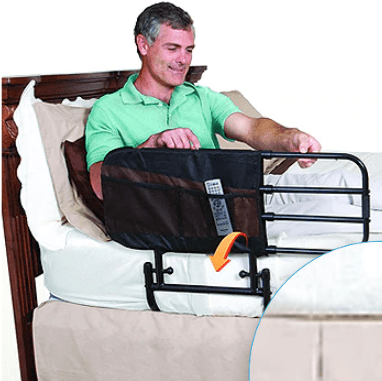 Stander EZ Adjust Bed RailDoubles as handle and night barrier Stander EZ Adjust Bed RailDoubles as handle and night barrier | Adjustable half-to-full rail | 300 lbs | Mod to High | ~$130–$200 |
| 02 | 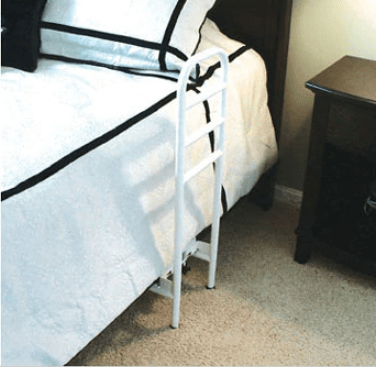 Drive Medical Adjustable Height Assist Handle★ Safest starting point Drive Medical Adjustable Height Assist Handle★ Safest starting point | Bed assist handleTransfer aid, not a rail | 250 lbs | Lowest | ~$30–$50 |
| 03 | 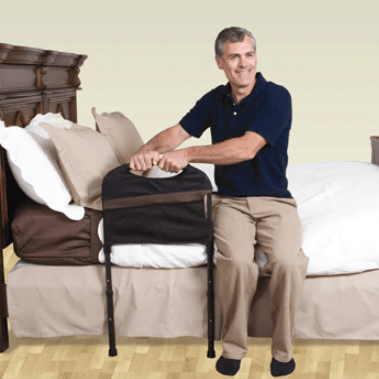 Stander Stable Adult Home Bed RailExtra floor-supported stability Stander Stable Adult Home Bed RailExtra floor-supported stability | Half rail with support legs | 300 lbs | Moderate | ~$60–$90 |
| 04 | 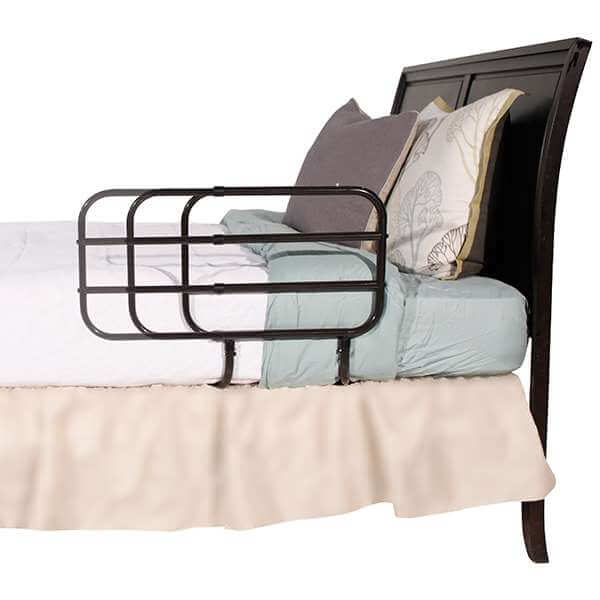 Able Life Bedside Extend-A-RailSwitches handle to fall barrier Able Life Bedside Extend-A-RailSwitches handle to fall barrier | Adjustable-length rail and handle | 300 lbs | Moderate | ~$100–$120 |
| 05 | 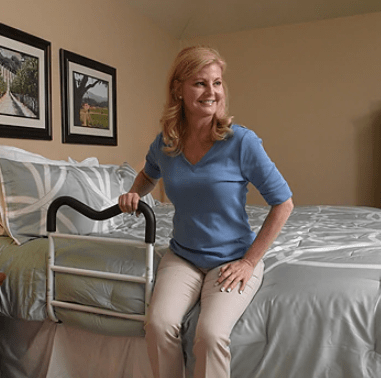 Drive Medical M-Rail Assist HandleMultiple grip positions Drive Medical M-Rail Assist HandleMultiple grip positions | Bed assist handle (M-shaped)Transfer aid, not a rail | 300 lbs | Lowest | ~$35–$55 |
* Entrapment risk reflects the product category, not a defect. A handle has the lowest risk because it is not a barrier; a full-length rail has the most barrier surface. Any rail used with the wrong mattress, an improper fit, or an inappropriate user can be dangerous. Always verify ASTM F3186-17 compliance and recall status. Rows tagged "Transfer aid, not a rail" are bed assist handles, a different category from the barrier rails, so their figures are not a like-for-like comparison against the rails.
Specs to verify before buying
- Some weight capacities and mattress ranges circulate on older listings and go out of date. We will not publish a safety-relevant figure we cannot verify. Before buying, confirm the exact weight capacity, rated mattress thickness range, ASTM F3186-17 compliance, and whether the model is rated for your bed type.
The Best Bed Rails for Adults and Seniors (2026)
Each pick below is a current model that states ASTM F3186-17 compliance or is verified in production at a major retailer. Always confirm current pricing, specs, and recall status before buying.
Stander EZ Adjust Bed Rail
Most adaptable
- TypeAdjustable half-to-full rail
- CertificationASTM F3186-17
- Weight capacity300 lbs
- Mattress fit~12" to 16" (not for adjustable beds)
Verified July 2026
The Stander EZ Adjust Bed Rail adjusts in length after installation, one of the few that do. It locks at three widths for use as a hand rail, half rail, or full-length rail, and pivots down 180 degrees for access. Dual safety straps secure it to most home beds.
Drive Medical Adjustable Height Home Bed Assist Handle
★ Safest starting point
- TypeBed assist handle (lowest entrapment risk)
- Handle dimensions32.75" D x 19.75" W x 13.5 to 16.5" H
- Weight capacity250 lbs
- Height adjustment15" to 20"
Verified July 2026
The Drive Medical Home Bed Side Helper assists with getting into and out of a home-style bed. It slides under the mattress, attaches to either side, and has no-slip foam on the base bar. The all-steel, chrome-plated build is easy to clean and assembles tool-free. As a bed assist handle, it is a low-entrapment-risk transfer aid, not a barrier.
Stander Stable Adult Home Bed Rail (STD5800)
Most stable
- TypeHalf rail with support legs
- CertificationASTM F3186-17
- Weight capacity300 lbs
- Mattress fit6" to 14" (in-home and hospital beds)
Verified July 2026
The Stander Stable Bed Rail STD5800 accommodates both in-home and hospital beds. Two non-slip legs plant on the floor for extra stability, and setup is tool-free. It includes a four-pocket organizer pouch.
Able Life Bedside Extend-A-Rail
Most versatile length
- TypeAdjustable-length rail and handle
- CertificationASTM F3186-17
- Weight capacity300 lbs
- Mattress fit8" to 15" (not for adjustable beds)
Verified July 2026
The Able Life Bedside Extend-A-Rail is a width-adjustable rail that doubles as a transfer handle. At the push of a button it extends from roughly 20" to 30", short for transfers, longer for nighttime fall protection, and installs on either side with a dual safety strap. A newer addition, it suits caregivers wanting one device that switches between transfer aid and partial barrier.
Drive Medical M-Rail Home Bed Assist Handle
Most grip options
- TypeBed assist handle, M-shaped (lowest entrapment risk)
- StatusVerified in production (July 2026)
- Weight capacity300 lbs
- FitSingle to king, strap around mattress; includes pouch
Verified July 2026
The Drive Medical M-Rail supports getting into and out of bed and helps a person sit up, reposition, stand, or transfer to a walker or wheelchair. Its contoured M-shaped handle with a padded, no-slip grip allows multiple hand positions, and extra-long straps wrap the mattress for a secure fit from single to king. It includes a pouch and assembles tool-free. As a bed assist handle, it is low entrapment risk.
Why Vive Health rails are not on this list
- Previously we featured Vive Health products, but we removed them. In March 2026, the CPSC and Vive Health recalled roughly 122,000 adult portable bed rails, including the Vive Health Compact Bed Rail (model LVA2009SLV) and Bed Rail Collection V (model LVA2097SLV), after two reported entrapment deaths and a finding that the rails violated the mandatory safety standard. We do not recommend any recalled model. If you own one, stop using it and contact Vive Health for a refund.
How to Choose: A Quick Decision Tree
Work through these steps in order. Arriving at a non-rail alternative is a valid, safety-first outcome.
Step 1: Cognitive Status
Does the individual have dementia, Alzheimer's, delirium, or frequent nighttime confusion?
Step 2: Mobility Goal
What is the primary physical requirement?
Step 3: Sleep Behavior
Could the person attempt to climb over a rail, or are they an exceptionally restless sleeper?
Step 4: Bed and Mattress Type
What is the current bed setup?
Step 5: Caregiver Presence
Is a caregiver available to actively raise and lower the rail?
Final step
- Whatever your endpoint, confirm the model complies with 16 CFR Part 1270 / ASTM F3186-17 and matches your mattress thickness.
Caregiver Scenarios
Parkinson's disease with tremor
Tremor and rigidity make a stable handhold valuable, but a long barrier rail adds little. A bed assist handle with a contoured, non-slip grip gives leverage for sitting up and standing without creating barrier gaps. Position it on the exit side and strap it firmly so it cannot shift during a transfer.
Post-stroke recovery with one-sided weakness
Weakness after a stroke is often concentrated on one side. A half rail placed on the affected side gives the person something to push and pull against, while leaving the stronger side open for normal exits. Pair the choice with input from the rehab team, since post-stroke mobility changes week to week.
Hospice or end-of-life care
This is not a portable-rail situation. A person in hospice is best served by a hospital bed with properly gapped, integrated rails, which the hospice provider can arrange and assess. The care team builds a fall- and entrapment-risk plan around that bed. Ask the hospice nurse rather than buying an aftermarket rail.
Dementia or nighttime wandering
Do not use a bed rail. For someone with dementia active at night, a rail invites climbing-over falls and entrapment. Safer options: a bed lowered close to the floor, a cushioned floor mat on the exit side, a hi-lo bed at its lowest setting at night, bed-exit alarms, and a sleeping environment the person can leave without a barrier. Talk to the physician about the wandering itself.
Managing any of these from a distance adds another layer. If you are coordinating care remotely, our guides to long-distance caregiving and coordinating care for an aging parent cover how to keep eyes on a setup you cannot check yourself every night.
What Else Should You Consider Before Buying?
Take a few minutes to outline your needs first. It will narrow your search faster.
- Does it meet the current safety standard? Non-negotiable. Confirm the rail states compliance with ASTM F3186-17.
- What is your price range? Bed rails generally cost $30 to $200, varying by design and features. Shop around.
- What type of bed? Box spring and mattress? Thick or heavy mattress? Adjustable bed? Many rails with legs or under-mattress bars are not rated for adjustable beds.
- How much does the user weigh? Always check weight capacity. Most home rails are rated to 300 lbs; bariatric rails exist for higher needs.
- How thick and firm is the mattress? A very soft mattress raises entrapment risk. Many manufacturers describe a "fist test": if the mattress edge compresses about 2 inches under roughly 12 lbs of pressure, it may be too soft.
- Where is the bed placed? Against a wall, you need one rail; in the middle of the room, you need dual rails.
- Will a caregiver manage the rail? Before buying for a facility, contact the facility about what may be installed.
- Does the person have dementia or cognitive impairment? If so, do not use a bed rail. See "Who Should NOT Use a Bed Rail" above.
Installation, Returns, and Warranty
Installation. Improper installation is a main cause of dangerous gaps. Each rail has its own instructions: some use straps and clips, others attach to the bed frame, others are weighted down by the mattress. Follow them exactly.
After installing, check that no gap is wide enough to trap a head or body along the rail, mattress, or frame, and re-check regularly, since rails shift and loosen over time. Use extra caution with soft, air, or specialty mattresses, which compress and create gaps.
Returns. Many bed rails and handles are non-returnable for hygiene reasons once opened, like other personal medical equipment. Others carry a restocking fee. Some Stander listings note a restocking fee plus return shipping at the buyer's expense, and require the product unused in original packaging.
Because you often cannot return a rail after opening it, confirm sizing, mattress compatibility, and bed-type fit before you order.
Warranty. Terms vary by manufacturer. Stander, for example, advertises a limited lifetime warranty. Register the product if offered, and keep your receipt; you will need proof of purchase for warranty claims and recall refunds.
What to Do After Choosing a Bed Rail
The CPSC and FDA recommend the following once a rail is in use:
- Confirm compatibility. Check with the manufacturer that the rail is compatible with your specific mattress and bed frame. These are not one-size-fits-all.
- Discourage climbing. Place the rail so it discourages climbing over it, which can cause a fall from rail height.
- Install for a gap-free fit. Install per the manufacturer's instructions, then check that no gap can trap a head or body.
- Inspect and readjust. Rails can shift or loosen over time, creating dangerous gaps. Re-check on a schedule.
- Check for recalls. Check CPSC.gov/Recalls and the manufacturer's site, before purchase and afterward.
- Use a care plan in facilities. For anyone in a long-term care facility, make sure a comprehensive assessment and care plan is in place first.
- Ask a clinician. For any specific medical question, talk to the user's physician, nurse, or home health clinician, and contact the manufacturer with product questions.
Frequently Asked Questions
Are bed rails safe?
They can be, for the right person, with the right product and fit. They can also be dangerous. The CPSC identified 284 entrapment deaths involving adult portable bed rails between 2003 and 2021. A federal mandatory safety standard (16 CFR Part 1270, incorporating ASTM F3186-17) took effect in 2023; rails made after August 21, 2023 are legally required to comply. Buy only a rail that states ASTM F3186-17 compliance, fit it with no head- or body-sized gaps, and re-check it regularly. If the user has dementia, is a restless sleeper, could climb over the rail, or is small-framed, a rail is the wrong choice. See "Who Should NOT Use a Bed Rail" above.
Who should not use a bed rail?
People with dementia or cognitive impairment, restless or active sleepers, anyone who could climb over the rail, and small-framed or frail individuals all face elevated entrapment risk. A rail must also never be used as a restraint to keep someone in bed against their will or ability. For each of these situations there is a safer alternative, such as a bed assist handle, a lower bed with a floor mat, a hi-lo bed, bed-exit alarms, or a hospital bed with integrated rails chosen with a clinician.
What safety standard should I look for?
Look for an explicit statement that the product passed ASTM F3186-17, the standard incorporated into the federal mandatory rule 16 CFR Part 1270. Before 2023, manufacturers had no obligation to meet any standard, and CPSC testing found most rails on the market did not comply, so older or unbranded listings may not be safe even if they are still for sale.
How much do bed rails cost?
Most home bed rails and assist handles cost between $30 and $200. Simple bed assist handles tend to sit at the lower end (roughly $30 to $55), while adjustable half-to-full rails run higher (roughly $100 to $200). Prices change frequently, so confirm current pricing before buying. Many rails are non-returnable for hygiene reasons once opened, which makes getting the size and bed-type fit right the first time important.
Can a bed rail be used to keep someone in bed?
No. Using a bed rail or strap to keep a person in bed against their will or ability is restraint, not assistance, and the FDA explicitly warns against it. Restraint without supervision is dangerous and can lead to suffocation, injury, neglect, or entrapment. If keeping someone safely in bed is the underlying concern, ask for a clinical fall-prevention assessment and discuss supervision, bed-exit alarms, and a hospital bed with the care team.
Does my mattress matter?
Yes, a great deal. A very soft mattress compresses and creates gaps that raise entrapment risk. Many manufacturers describe a "fist test": if the mattress edge compresses about 2 inches under roughly 12 lbs of pressure, it may be too soft for a rail. Always confirm the rail's rated mattress thickness range, and re-check the fit over time, since soft, air, and specialty mattresses change shape with use.
About the experts

Dan Fogarty has more than 12 years of experience in healthcare management and strategic communication. He earned his Master's in Health Communication from Johns Hopkins University and served as Chief Administrative Officer of the NIH Clinical Center and Chief Intramural AO for the National Heart, Lung and Blood Institute for 12 years. He is currently Senior Advisor for Strategic Operations, Management and Technology for SAMHSA, a Fellow of the American College of Healthcare Executives (FACHE, 2021), and Adjunct Faculty at MCPHS.
Connect on LinkedIn
Brooke Lounsbury has over 26 years of nursing experience with a primary focus on home health and hospice, where fall prevention and safe bed setups are part of the daily work. She creates continuing-education courses for nurses at PedagogyEducation.com and has written for Jase Medical and The Wellness Company on senior health topics.
Sources
- U.S. Consumer Product Safety Commission. Adult portable bed rails: mandatory safety standard, 16 CFR Part 1270 (incorporating ASTM F3186-17).
- U.S. Consumer Product Safety Commission. Vive Health adult portable bed rail recall, March 2026.
- U.S. Food and Drug Administration. A Guide to Bed Safety: Bed Rails in Hospitals, Nursing Homes and Home Health Care.
- ASTM F3186-17, Standard Specification for Adult Portable Bed Rails and Related Products.
All featured products were verified for production status and stated ASTM F3186-17 compliance within 30 days of publication. Pricing and availability are subject to change. We remove any product that is recalled.
Related Reading
- How to Select the Best Bed Rails for My Aging Parent
- A Safe Bedroom for Someone With Limited Mobility
- Top Stair Lift Companies, Compared
More From Caring Village


Affiliate Disclosure
Caring Village may earn a commission when you buy through links in this article, at no extra cost to you. Recommendations are chosen by our team of expert contributors and are not influenced by commission. We only recommend products meeting current FDA and CPSC safety guidance for adult portable bed rails (the ASTM F3186-17 standard), and we remove any product that is recalled. When our guidance points a reader toward a safer non-rail alternative, or toward talking to a clinician instead of buying, that is intentional. Your loved one's safety comes before any sale.