Caring for Someone With COPD at Home: A Family Guide
What a nurse watches for during a COPD visit, turned into a plan a family can run between visits: daily medicines, breathing techniques, oxygen safety, flare-up zones, and the first weeks after a hospital stay.

 Medically reviewed by Brooke Lounsbury, RN
 General information for families, not medical advice. Medicine, oxygen, and flow-rate decisions belong to the person’s care team, and nothing here replaces their instructions. Caring Village reviewed guidance from the NHLBI, the American Lung Association, and the CDC, and earns no commission from any link on this page.
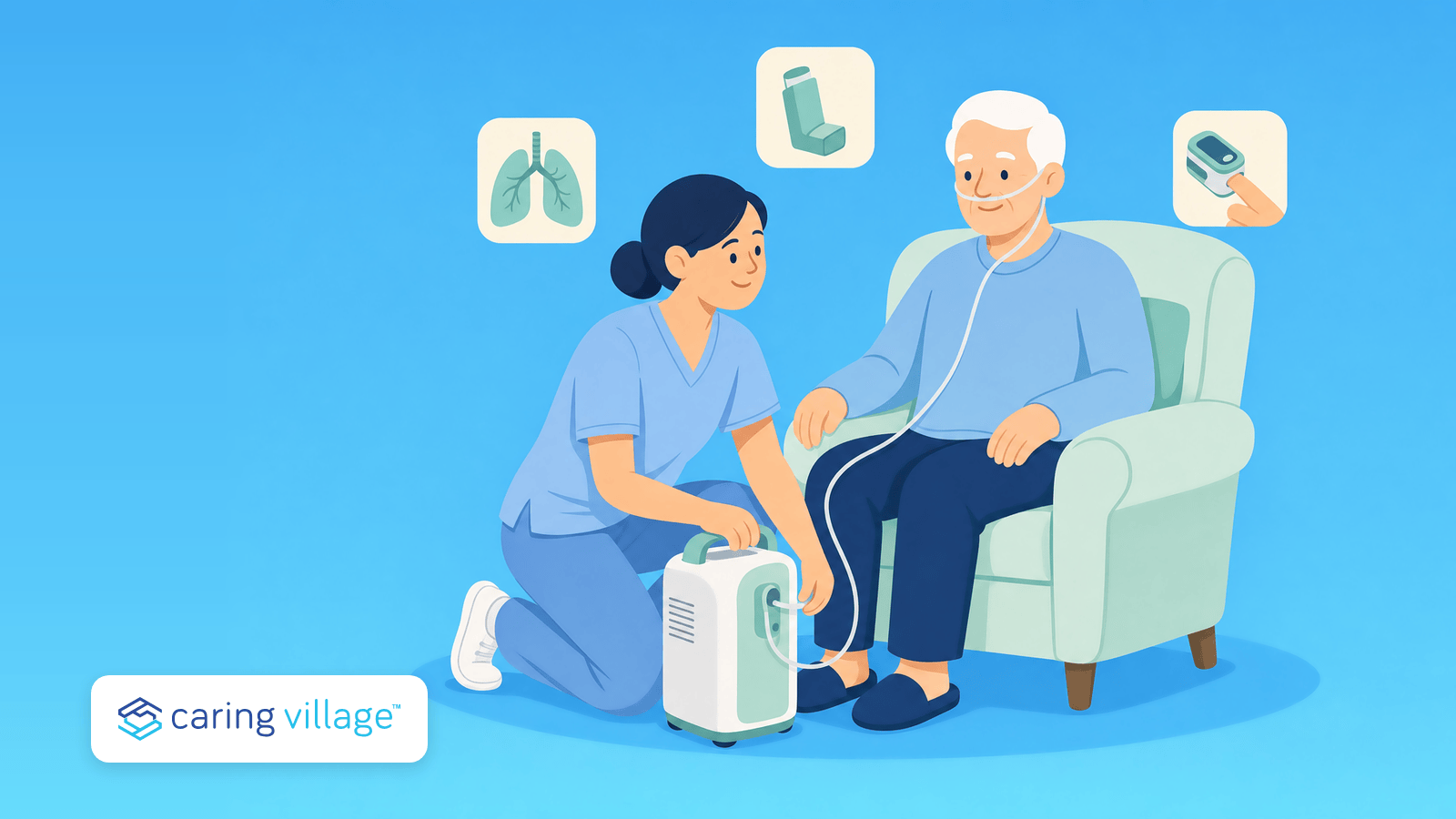
Caring for someone with COPD at home comes down to four jobs: give the daily medicines correctly, catch a flare-up early, keep oxygen and triggers safe, and know who to call as symptoms change.
A nurse runs that sequence on every visit. A family can run the same sequence between them, and this page is written for the version that happens at eleven at night, not for a nursing exam.
If the diagnosis is recent and the routine is still forming, the broader guide to caring for someone with COPD covers the basics this page builds on.
✓ Verified Every clinical instruction below links to the organization that publishes it.
Where Are You Right Now?
Jump to the part of COPD care you are actually dealing with today.
What COPD Home Care Means for a Family
Nurses working with COPD spend their time on four things: symptom control, prevention, safe device technique, and escalation. None of that needs a license to understand.
Escalation is where families hesitate. A flare-up is a sudden worsening of symptoms that may last two days or more and may not go away on its own, which is exactly why the response gets written down in advance instead of decided at the moment it is hardest to think.
What the Family Runs
Every day, between appointments.
- The daily medicine routine and the refills behind it
- Device technique, cleaning, and spare canisters
- Trigger control at home, including smoke and air quality
- Watching for the early signs of a flare-up
- Getting to appointments and rehab sessions
- Keeping the plan and contact list where everyone can see them
What the Clinical Team Owns
Decisions that should never be made at home.
- Which medicines, how much, and when they change
- The oxygen prescription and the flow rate
- Diagnosing an infection and prescribing for it
- Referrals to pulmonary rehab, home health, and equipment
- Interpreting test results and oxygen readings
- Every update to the written action plan
The line is clearest on oxygen. The American Lung Association’s instruction is flat: never change the flow rate from what the doctor prescribed. If breathing seems worse, that is a reason to use the action plan, not a reason to turn a dial.
The One-Screen Home COPD Plan
Caregiver guidance for COPD arrives scattered: a toolkit here, an action plan there, a breathing video somewhere else. This is the whole thing on one screen, sorted by how often each part actually needs attention.
| Part of the Plan | Today | Every Week | Before Appointments |
|---|---|---|---|
| Caring Village Care Coordination Layer | Keeps the action plan, medication list, and who-to-call names of a home COPD routine open to everyone helping, with role-based access. Used by over 85,000 families. | ||
| Breathing techniquesPracticed calm, used under stress | Practice pursed-lip breathing once while calm | Use it on stairs and after standing up | Ask which technique helps this person most |
| Medicines and devicesDaily inhaler plus rescue inhaler | Give the daily long-acting medicine even on a good day | Check refill dates and how much is left in each device | Bring every inhaler to the visit for a technique check |
| Home environmentSmoke, fumes, and air quality | Keep the home smoke-free, including visitors | Check local air quality before outings | Report symptoms that followed a specific exposure |
| Written action planGreen, yellow, red | Post it where it is visible, not filed away | Re-read the yellow-zone steps out loud | Ask for an updated plan after any medicine change |
| Infection preventionFlare-ups often start as infections | Wash hands before helping with devices | Move visits when someone is sick | Ask which vaccines are due |
| Oxygen safetyOnly if oxygen is prescribed | Keep heat and flame five feet clear | Test smoke alarms, check the extinguisher | Confirm the backup tank and delivery schedule |
| Movement and rehabThe most skipped part of COPD care | One short planned walk or seated set | Keep rehab sessions on the calendar | Ask about a pulmonary rehab referral |
| Caregiver supportThe part that gets cut first | Name a backup for tonight | Protect one block of non-caregiving time | Say out loud what is not working |
Scroll the table sideways to see the weekly and pre-appointment columns.
Download the ungated one-page COPD action plan to print and complete with the care team. Prefer one live copy every helper can reach? Build the COPD care plan in Caring Village.
Print it, or keep it where the whole care team can open it. The NHLBI COPD Caregiver’s Toolkit is worth downloading alongside it: its five modules carry printable forms for medications, vaccinations, contacts, and the period right after a flare-up.
If this is the family’s first structured plan, the guide to building your caregiving plan covers how to divide the work before all of it lands on one person.
Daily Medicines and Devices: The Part That Slips First
COPD treatment usually mixes two kinds of inhaled medicine that behave nothing alike. Confusing them is the most preventable mistake in the house.
Taken when symptoms show up
Short-acting medicine relaxes the airways and works within minutes. It is the one that gets reached for during a bad stretch.
The relief wears off in a few hours. Needing it more often than usual is itself a signal worth reporting.
Taken every day, good day or bad
Long-acting medicine reduces swelling and inflammation in the airways and prevents symptoms rather than chasing them.
It has to be taken every day, even when the person feels well, which is exactly when families quietly start skipping it.
Medicine categories described by the American Lung Association. Which medicines, and how much, is set by the prescriber.
Technique matters as much as the prescription. NHLBI puts it plainly: it is normal to have trouble with an inhaler, so take the inhaler to the appointment and have the care team watch it being used.
Between visits, the American Lung Association publishes step-by-step videos for each device type, spacers and nebulizers included.
Two habits prevent most refill emergencies: keep one list, not one per person, and put each refill date on a calendar with a name attached. If the household wants reminder software too, the roundup of medication reminder apps compares what each one actually tracks.

The Medication List Lives in One Place Every Helper Can Open
A daily inhaler and a rescue inhaler get mixed up when the list lives in one person’s memory. Caring Village stores the current list with a photo of each device, so every helper reads the same page.
- A photo of the inhaler and the bottle label
- Refill dates as to-dos with a named owner
- Past medicines kept beside current ones
- Used by over 85,000 families, 4.5 stars on the App Store
Two Breathing Techniques To Practice Before You Need Them
Both techniques are taught in pulmonary rehabilitation, and both work better when they are already familiar. Practicing them on a calm afternoon is what makes them available on a bad night.
1) Pursed-Lip Breathing
This slows the pace of breathing and keeps the airways open longer, so more air moves in and out.
- Sit down and relax the neck and shoulder muscles.
- Breathe in slowly through the nose, keeping the mouth closed.
- Purse the lips as if about to whistle or gently blow out a candle.
- Breathe out slowly and gently through pursed lips, longer than the inhale.
- Repeat, inhaling through the nose and exhaling through pursed lips, until breathing settles.
Steps from the American Lung Association, which adds a hard stop: if shortness of breath continues, call 911 and seek immediate medical attention.
2) Belly Breathing, Also Called Diaphragmatic Breathing
This one slows the breathing rate so the person uses less energy to breathe, which is why it helps most after exertion.
- Sit up straight in a comfortable chair, or lie down.
- Put both hands on the belly.
- Close the mouth and take a slow, deep breath in through the nose, letting the belly get bigger like a balloon.
- Blow all the air out slowly through pursed lips, as if blowing bubbles.
- Continue for five to ten minutes, keeping neck and shoulders relaxed.
Steps from the American Lung Association.
One Honest Note About the Tripod Position
Leaning forward with hands on the knees is a posture people with COPD often take when short of breath, and most caregiver guides present it as a technique. A small study of adults with stable COPD found no significant difference in breathing measurements between that position and ordinary sitting.
Use it for comfort while the medicine works, not as a substitute for the action plan.
Green, Yellow, Red: The Flare-Up Plan
Every COPD action plan is built on three zones, and knowing which zone the day belongs to is the most useful skill a family caregiver can carry. All three definitions below come from the American Lung Association’s COPD Action and Management Plan.
No COPD symptoms. The person feels good. This is where you want every day to sit.
What to doKeep taking the long-term control medicines and use oxygen as prescribed, even on a good day.
Who to callNobody. Hold the routine.
More symptoms than usual: increased shortness of breath, tiredness, and coughing, or phlegm that changed color or consistency.
What to doSlow down and follow the written plan, which may include quick-relief medicine or starting an antibiotic or other medicine already prescribed.
Who to callThe healthcare provider, if symptoms do not improve after treatment.
Severe shortness of breath even at rest, chest pain, coughing up blood, or chills. Blue or gray lips, fingertips, or nails, racing heart, confusion, or fever.
What to doThis is not a wait-and-see night.
Who to callCall 911 or seek medical care immediately.
Name the early signals out loud so two people watch for the same things: more coughing, a change in the mucus, trouble sleeping, more shortness of breath, wheezing, and more fatigue.
The American Lung Association lists those as common flare-up signs, and they usually arrive before the yellow zone feels obvious.
The plan itself comes from the provider, not a website. Ask for it by name at the next appointment, then post it where a tired person can read it at night.
Oxygen at Home: The Rules That Are Not Negotiable
Oxygen itself is not flammable. It supports combustion, so materials burn more readily in an oxygen-enriched room. That single fact explains every rule below.
Keep sources of heat and flame at least five feet from where the oxygen unit is used or stored. Source: American Lung Association, Using Oxygen Safely.
Always
- Post “No Smoking” and “No Open Flames” signs inside and outside the home
- Keep a working fire extinguisher and smoke alarms close by
- Use water-based products on skin and lips
- Keep a liquid oxygen unit upright at all times
- Keep concentrators several inches from walls and curtains
- Turn the oxygen off when it is not being used
Never
- Smoke, or let anyone smoke nearby
- Use oxygen while cooking with gas
- Use hair dryers, curling irons, heating pads, or electric razors while wearing oxygen
- Spray aerosols such as air freshener or hairspray near the unit
- Use vapor rubs, petroleum jelly, or oil-based lotion
- Store oxygen in a closet, a trunk, or any enclosed space
- Cut the tubing, or run more than a fifty-foot length
- Plug a concentrator into an extension cord or share its outlet
Full list from the American Lung Association’s oxygen safety guidance, page last updated January 2026.
Two preparation steps get skipped and matter most in a storm. Tell the power company the home has life-sustaining equipment, and keep backup equipment on hand, normally a large oxygen tank.
Where outages are common, a generator is worth considering, and the supplier needs notice well before refills run low.
If someone wears oxygen while sleeping, the American Lung Association says to consider 100% cotton bedding because it is less likely to cause static electricity.
An Action Plan Only Works If Everyone Can Open It
An action plan only helps if the person on the night shift can read the yellow-zone steps. Caring Village keeps it with the oxygen and pulmonary contacts as shared documents, with role-based access deciding who opens them.
- Action plan pinned to the top of the folder
- Oxygen supplier and after-hours numbers together
- Access set separately for family and paid aides
Save Breath for the Things That Matter
Dressing, bathing, and housekeeping cost more energy with COPD, and each one can leave a person tired or short of breath. The American Lung Association teaches energy conservation as the five P’s, and they are easy to hand to anyone helping.
- Pace yourself. Rest between activities, and rest before fatigue arrives, because recovery takes much longer once someone is overtired.
- Plan ahead. Do not stack laundry, grocery shopping, and an appointment into the same day.
- Position yourself. Sit and stand upright, and avoid excessive bending or reaching, which brings on shortness of breath.
- Prioritize. Do what matters most when energy is highest and let the rest wait.
- Pursed-lip breathing. Practice it daily until it is automatic, then use it on the stairs.
Mornings are usually the hardest part of the day, with more cough, more mucus, and more breathlessness.
The fixes are unglamorous: schedule appointments later in the day, lay clothes out the night before, keep water on the nightstand, and bathe when there is energy for the task and room to rest after.
The home setup does quiet work too. NHLBI suggests putting frequently used items in one easy-to-reach place, using a small wheeled cart, keeping a reacher nearby, and choosing loose clothing and easy shoes.
In the bathroom, a raised toilet seat for breath-saving transfers removes one of the day’s more taxing movements. In the hallway, a walker for stability while short of breath shortens the stop-and-rest trips.
Prevent the Flare-Ups You Can Prevent
Triggers are personal, but the common ones are consistent. Smoke of every kind counts, including secondhand smoke, wood fireplaces, and burning leaves.
So do strong odors, dust, chemicals, and fumes from perfumes, deodorants, and cleaning supplies, which is why fragrance-free products are the easy swap. The American Lung Association lists both groups as leading triggers.
Air quality belongs on the same list. NHLBI advises staying indoors when air quality is poor and considering an air filter, noting that wildfires and extreme heat make this more frequent.
Anyone still smoking can reach a cessation counselor through the American Lung Association Lung HelpLine at 1-800-586-4872.
Vaccination is the other half of prevention. The American Lung Association states plainly that people with COPD are at higher risk for severe respiratory illness and should stay up to date on flu, COVID-19, RSV, and pneumococcal vaccines.
| Immunization | Typical Timing |
|---|---|
| Flu | Every year, in the fall |
| COVID-19 | Every year, as recommended |
| RSV | Usually once, based on age and risk |
| Pneumococcal | Based on age and risk |
| Tdap | Across the lifespan |
Timing table from the American Lung Association. Which of these apply to one person depends on age, history, and risk, and the CDC’s adult immunization schedule sorts recommendations by medical condition. Bring the question to the next appointment rather than deciding at the pharmacy counter.
Pulmonary Rehab Is the Most Skipped Step
Pulmonary rehabilitation is a supervised medical program that teaches exercises and breathing techniques to people living with lung disease.
NHLBI describes the benefits as gaining strength, reducing symptoms of anxiety or depression, and making routine activities, work, and social outings easier to manage.
It is not only a hospital program. NHLBI notes rehab can happen in a hospital or clinic, or at home with physical therapy, breathing exercises, activity monitors, or smartphone-based lessons.
That matters when transport, not willingness, is the real barrier.
The ask at the next visit is short: is pulmonary rehab appropriate, is there a local program, and is a home or remote option available. Rehab carries few risks, and the supervised team stops the activity and treats the problem if anything goes wrong during a session.
Coming Home After a Hospital Stay
Being hospitalized once for COPD raises the risk of being hospitalized again, which is why the discharge conversation deserves more attention than it usually gets.
Ask these before the discharge paperwork is signed.
Discharge Questions Worth Asking Out Loud
Question list from the American Lung Association’s Hospital to Home Care guidance.
- Can you show me the steps to take the COPD medication correctly?
- Have the maintenance or daily medicines changed?
- What symptoms should worry us, and what do we do if they get worse?
- Can we go over the COPD action plan together?
- How do we more effectively bring up mucus and keep the airways clear?
- How can breathing exercises help with shortness of breath?
- Is there help paying for the medication?
- Who do we talk to about supplemental oxygen?
- Where do we get help at home or order equipment like a walker or shower chair?
Recovery is slower than families expect. Depending on the flare-up, it may take a few days to several weeks, with lingering symptoms like a heavier cough or more mucus.
Watch those, and report them if they worsen. Plenty of water, extra rest, paced activity, and asking for help are part of the plan, not a sign it is failing.
Book the follow-up with the primary care provider before leaving the building.
If recovery needs more clinical support than the family can give, the guide to hiring a nurse for home care explains the difference between a home health aide, a licensed nursing assistant, and a private duty registered nurse.
Follow-Ups and Rehab Sessions Land on One Calendar
The weeks after a hospital stay carry a follow-up visit, rehab sessions, and an oxygen delivery. Caring Village puts them on one shared calendar with a named owner for each, so nobody assumes a sibling already booked it.
- Recurring rehab sessions with a driver assigned
- The follow-up visit visible to the whole village
- Reminders before oxygen deliveries
Care for the Caregiver
The NHLBI toolkit gives caregiver self-care its own module for a reason: the person coordinating COPD care is usually the one with no backup.
Its five modules cover managing COPD, managing the home, preparing for doctor visits, handling flare-ups and hospital stays, and looking after yourself.
Two things help more than advice. Name a specific backup person for a specific night, and hand off one recurring task completely rather than half of everything.
Cooking is usually the easiest hand-off, and meal delivery during recovery buys back the hour that disappears first. It helps on both sides: NHLBI notes that shortness of breath and fatigue can make it hard to eat enough, which raises the risk of infection.
Frequently Asked Questions
What is the difference between a rescue inhaler and a daily inhaler?
Quick-relief medicine relaxes the airways within minutes and is taken when symptoms appear, but it wears off in a few hours. Long-acting medicine prevents symptoms and has to be taken every day, even when the person feels well. Keep both on the same written list so whoever is helping can tell them apart.
What should a family do in the first minutes of a COPD flare-up?
Follow the written action plan rather than improvising. In the yellow zone, the American Lung Association’s guidance is to slow down and follow the plan’s steps, which may include quick-relief medicine or a medicine already prescribed, then call the provider if symptoms do not improve after treatment. Severe shortness of breath at rest, chest pain, coughing up blood, confusion, or blue or gray lips or fingertips is a red-zone situation: call 911 or seek medical care immediately.
How far should home oxygen stay from heat and flames?
At least five feet from anywhere the unit is used or stored, according to the American Lung Association. That includes gas stoves, candles, fireplaces, and space heaters. Nobody should smoke in the home, and a working fire extinguisher and smoke alarms belong close by.
Which vaccines do people with COPD usually need?
The American Lung Association says people with COPD should stay up to date on flu, COVID-19, RSV, and pneumococcal vaccines. Flu is annual in the fall, COVID-19 is annual as recommended, and RSV and pneumococcal go by age and risk. Confirm the exact set with the care team using the CDC’s adult immunization schedule by medical condition.
Can pulmonary rehabilitation happen at home?
Sometimes. NHLBI notes rehabilitation may take place in a hospital or clinic, or a person may learn physical therapy or breathing exercises to do at home, potentially using activity monitors or smartphone-based lessons. Ask the provider whether a local, home, or remote option exists.
Should the family buy a pulse oximeter?
A reading only helps if the care team has said what to do with it. Rather than picking a target number at home, ask the provider what reading should prompt a call and what should prompt emergency care, then write that into the action plan. Symptoms and the plan stay the primary guide.
The Bottom Line
Good COPD care at home is unglamorous and repeatable.
The daily medicine gets taken on good days as well as bad ones, the action plan is posted where a tired person can read it, oxygen stays five feet clear of anything hot, and the follow-up sits on a calendar rather than in someone’s memory.
The two things most families are missing are a pulmonary rehab referral and a written plan that names who to call in each zone. Both are one question at the next appointment.
And whoever is coordinating should not be the only person who knows any of it.
Keep the COPD Plan, Medicines, and Appointments in One Shared Place
Caring Village keeps the action plan, the medication list, the oxygen contacts, and the appointment schedule beside the daily updates the rest of the family is waiting for. Used by over 85,000 families.
- Shared care plan and contacts
- Medication and appointment reminders
- Private, encrypted family updates
“Caring Village has been a lifesaver for our family. My siblings live in different states, and now everyone stays in the loop without me having to repeat myself constantly.”
Daughter and primary caregiver
This guide is general educational information and is not medical advice. COPD medicines, oxygen prescriptions, flow rates, oxygen-reading targets, and vaccination decisions belong to the person with COPD and their clinician. Talk to the care team before changing any part of a treatment plan, and follow the written action plan they provide.
Sources
- American Lung Association, COPD Action Plan and Management Tools
- American Lung Association, Using Oxygen Safely
- American Lung Association, Breathing Exercises
- American Lung Association, Prevent a COPD Exacerbation or Flare Up
- American Lung Association, Managing Your Daily Activities
- American Lung Association, Hospital to Home Care
- American Lung Association, COPD Medications and COPD medication devices
- American Lung Association, Vaccines for Lung Health
- NHLBI, The COPD Caregiver’s Toolkit
- NHLBI, Living With COPD
- NHLBI, Pulmonary Rehabilitation
- CDC, Adult Immunization Schedule by Medical Condition
- Bhatt SP et al., Effect of tripod position on objective parameters of respiratory function in stable COPD, Indian J Chest Dis Allied Sci, 2009